




Distillery, Real life, Science
The Arabian Influence on Distillation
Feb
The next time you pour a gin and tonic, enjoy a fine whisky, or even use a perfume, you are benefiting from scientific breakthroughs that took place more than a thousand years ago. Much of what makes modern distillation possible can be traced back to scholars of the medieval Islamic world.
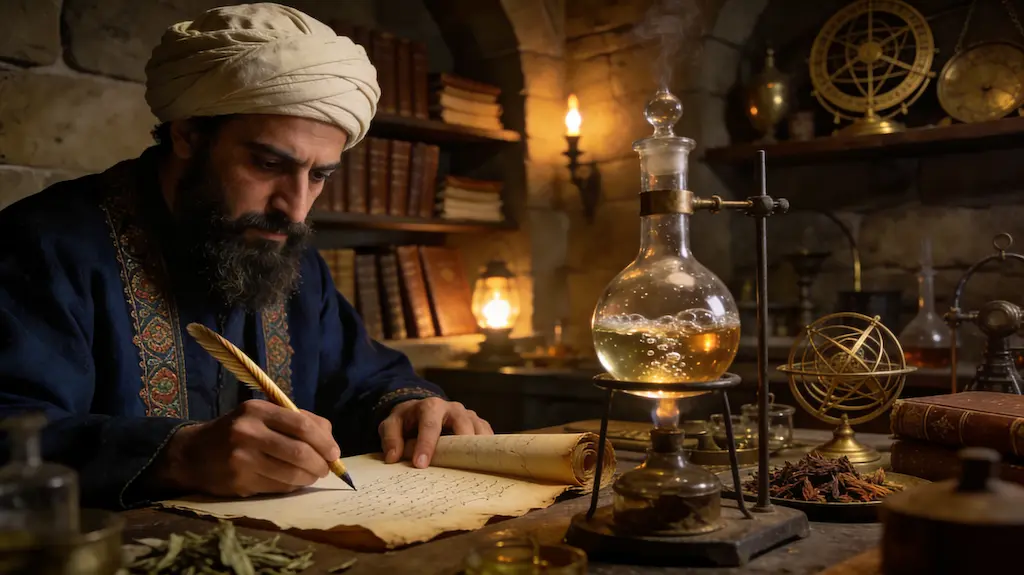
Between the eighth and thirteenth centuries, during what is often called the Islamic Golden Age, scientists transformed distillation from a rough technique into a precise and methodical process. Their work laid the groundwork not only for spirits production, but for chemistry as a discipline.
From Experiment to Precision
Basic distillation techniques were known in ancient Egypt and Greece. However, it was scholars in the Arab world who refined the process. They improved the control of heat, managed vapour more effectively, and designed better systems for cooling and collecting condensed liquids. In modern terms, they turned experimentation into repeatable science.
One of the most influential figures was Jabir ibn Hayyan. His writings described laboratory methods, chemical classification, and apparatus design in remarkable detail. He is widely credited with refining the alembic, an early distillation vessel that remains the conceptual ancestor of the modern pot still found in distilleries today.
Interestingly, the primary focus at the time was not beverage alcohol. Distillation was used to produce medicines, extract plant essences, and create perfumes. The emphasis was on purification and precision. That focus on refinement continues to define quality distillation today.
How the Knowledge Spread
From the twelfth century onward, Arabic scientific works were translated into Latin and circulated across Europe. Monasteries and universities adopted these methods, initially using them to create medicinal tinctures and botanical extracts.
Over time, the same techniques were applied to wine, leading to the production of stronger distilled spirits. While the purpose evolved, the scientific principles remained rooted in earlier Arab scholarship.
Where the Word Alcohol Comes From
Even the word alcohol reflects this heritage. It comes from the Arabic term al kuḥl, which originally referred to a finely powdered cosmetic used as eyeliner. The broader meaning of the word implied something purified or refined through careful processing.
As the term moved into European scientific language, it came to describe substances obtained through distillation. Eventually, it became closely associated with distilled spirits and later with ethanol specifically.
Why It Still Matters Today
Modern distilleries rely on the same core principles established more than a millennium ago. Careful temperature control, separation of fractions, and the pursuit of purity remain essential. Whether in a craft distillery, a pharmaceutical lab, or a fragrance house, the process follows the same scientific logic refined during the Islamic Golden Age.
The technology may be more advanced, but the foundations remain unchanged. Every modern still operates on principles shaped by scholars who approached distillation with patience, precision, and a commitment to understanding how substances could be purified and perfected.