




May
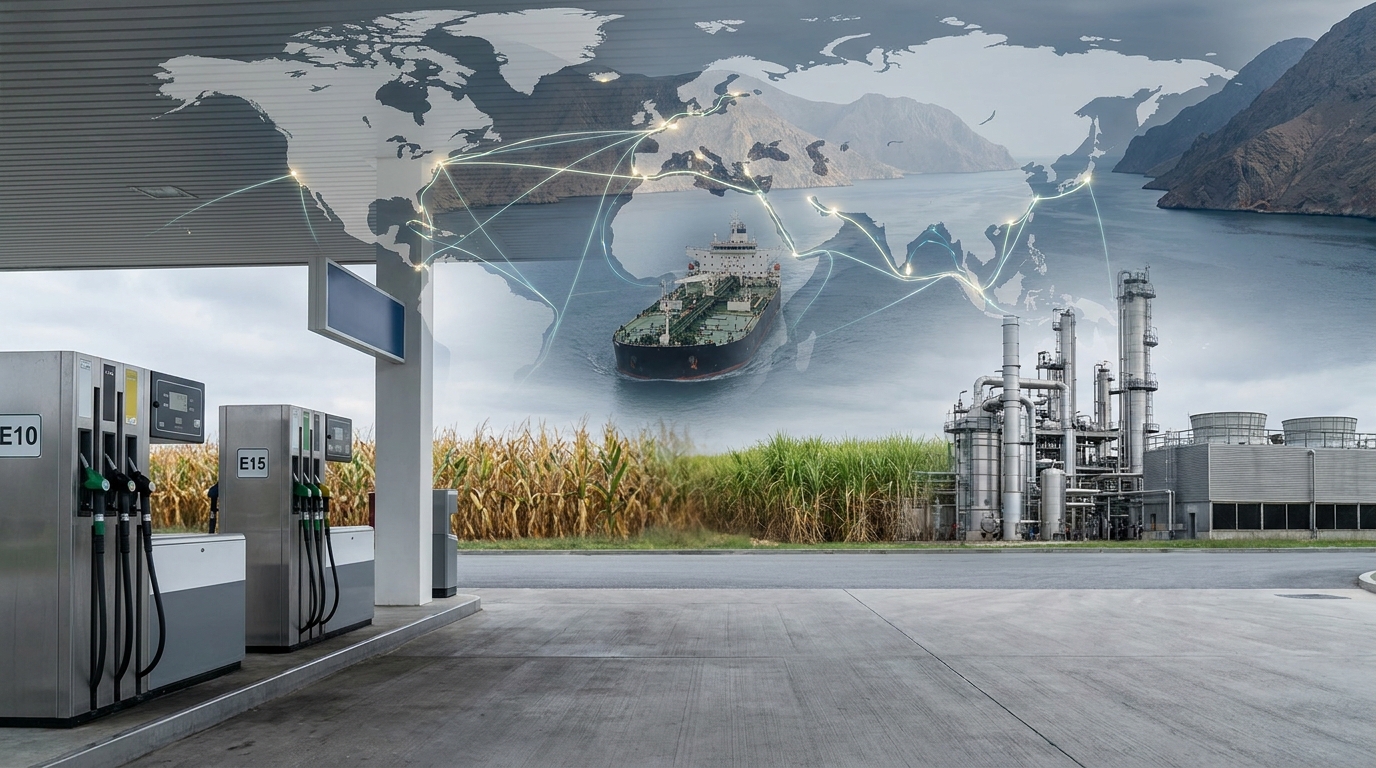
The ongoing instability around the Channel of Hormuz has once again highlighted how dependent the modern world remains on oil. With roughly a fifth of global petroleum shipments passing through the region, any disruption has an immediate effect on fuel prices and supply chains worldwide. In situations where fuel availability is reduced by 20% or more, one question often raised is why ethanol cannot simply be used to offset part of the shortage.
In reality, ethanol has already become an important supplementary fuel in many countries. Blends such as E10 (10% ethanol, 90% petrol) and E15 are widely used across the world, and most modern petrol vehicles can operate on these mixtures without modification. However, this compatibility was not always guaranteed. Ethanol and petrol behave differently chemically, particularly when it comes to their interaction with plastics, rubbers, and metals used in fuel systems.
Older vehicles were designed for pure petrol and often used materials that degrade when exposed to ethanol. Ethanol is more polar than petrol and can absorb water from the atmosphere, which increases the risk of corrosion and material breakdown. Certain older rubber compounds, cork gaskets, natural rubber hoses, and some fibreglass fuel tanks can soften, crack, or deteriorate over time when exposed to ethanol-blended fuels.
To support fuels such as E10 and E15, manufacturers gradually adopted more ethanol-resistant materials in fuel systems. Common compatible materials include fluorocarbon elastomers such as Viton, high-density polyethylene (HDPE), PTFE (Teflon), stainless steel, and modern nylon-based plastics. Fuel hoses in newer vehicles are also commonly manufactured using ethanol-resistant synthetic rubbers such as fluorosilicone or upgraded nitrile compounds. These materials prevent swelling, cracking, and fuel permeation issues that would otherwise occur with prolonged ethanol exposure.
One of ethanol’s advantages is that it raises the octane rating of fuel. Ethanol has a naturally high octane number, which can improve resistance to engine knocking and allow for more efficient combustion in high-compression engines. However, ethanol contains less energy per litre than petrol. Pure petrol contains roughly 34.8 MJ/L of energy, while ethanol contains around 21.2 MJ/L. This means a vehicle running on high ethanol blends generally consumes more fuel to travel the same distance.
Fortunately, with lower blends such as E10 or E15, the reduction in fuel economy is relatively small. In normal driving conditions many motorists barely notice the difference, especially since modern engine management systems automatically compensate for the altered fuel characteristics.
Producing fuel-grade ethanol is also more technically demanding than many people realise. Conventional distillation alone cannot produce completely dry ethanol because ethanol and water form what is known as an azeotrope. Under normal atmospheric distillation, the maximum purity achievable is approximately 97.2% ethanol by volume. Beyond this point, the remaining water cannot be removed through ordinary distillation because the ethanol-water mixture vaporises at a fixed ratio.
For fuel applications, ethanol typically needs to reach around 99.5% purity or higher in order to prevent water contamination and phase separation when blended with petrol. Achieving this level of purity requires additional dehydration processes after distillation. Modern ethanol plants commonly use molecular sieve adsorption systems, where specialised zeolite materials selectively absorb water molecules while allowing ethanol to pass through. Other dehydration techniques may include membrane separation, pressure swing adsorption, extractive distillation, or azeotropic distillation using additional chemical agents.
Although ethanol cannot fully replace global petrol demand overnight, it remains one of the few large-scale liquid fuel alternatives already integrated into existing infrastructure. Countries such as Brazil have demonstrated that significant ethanol usage can reduce dependence on imported oil and improve fuel supply resilience during geopolitical disruptions. However, expanding ethanol use further would still require balancing agricultural production, refining capacity, infrastructure compatibility, and environmental considerations.